AI as a helpful assistant in a workplace audit

Role

Experience Designer

Client

Multinational Food Company

Services

UX Strategy, AI Workflow Design, Product UI, Prototyping

Role

Experience Designer

Client

Multinational Food Company

Services

UX Strategy, UX Research, Onsite Workshop Facilitation, ServiceNow

We designed an AI-powered audit readiness workspace to help safety and quality teams find the right documents faster, review incident evidence, and prepare more confidently for audits and inspections.

We designed an AI-powered audit readiness workspace to help safety and quality teams find the right documents faster, review incident evidence, and prepare more confidently for audits and inspections.

We designed an AI-powered audit readiness workspace to help safety and quality teams find the right documents faster, review incident evidence, and prepare more confidently for audits and inspections.

The Story

For Safety managers, preparing for an audit or inspection is usually stressful and time-consuming. They have to go searching for documents, verify incident logs, and piece together what happened if things weren't documented perfectly from the beginning.

From use case to reality

By leveraging generative AI, we wanted to build a product that could instantly parse through their dense documentation and logged data, pulling up the exact information and specific details needed to be audit-ready on demand.

Key Outcomes

Decrease the financial cost of audits by helping employees to be audit-ready with minimal external support

Minimise nonconformities reported by anticipating and addressing potential issues prior to the audit

Shorten the length of audits by reducing the retrieval time of information requested mid-audit

AI Model

Using HybridRAG technology for unstructured, multimodal data

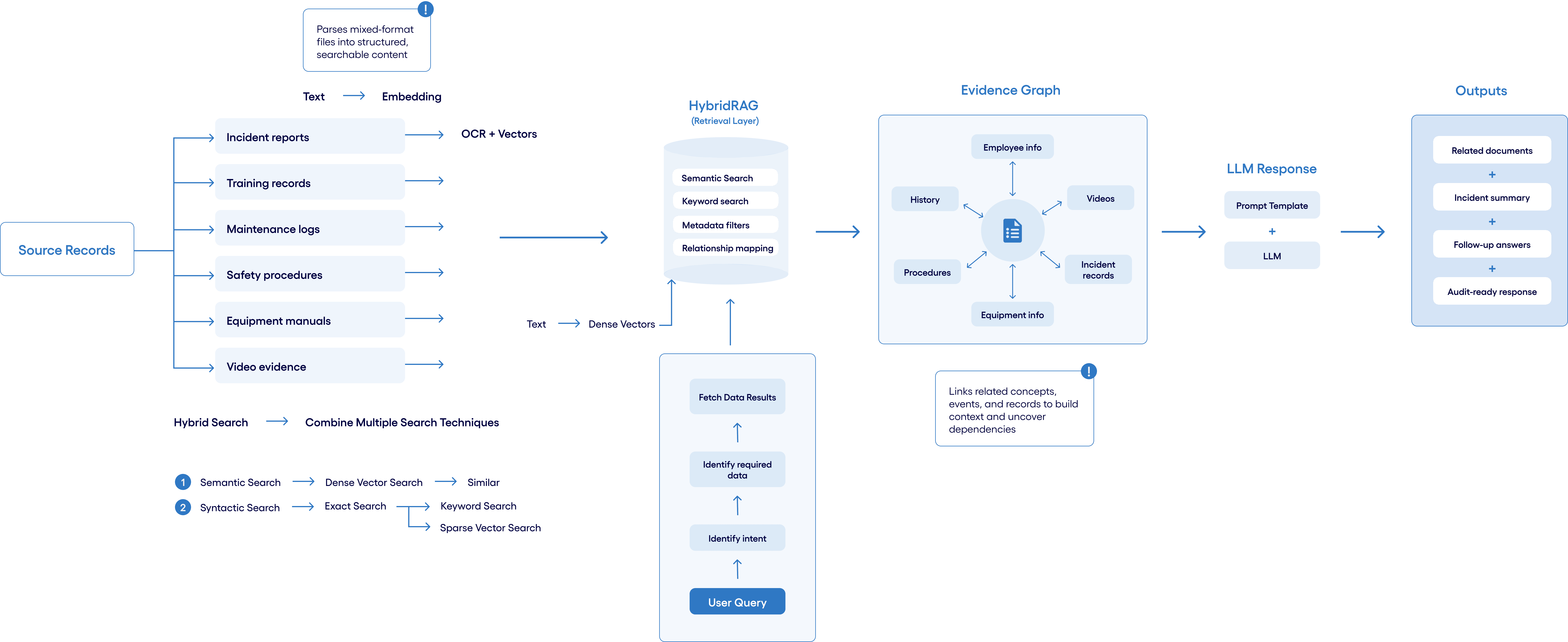
We needed to know exact dates, equipment, employee data, safety procedures, etc and the relationships between them. Because the source material came in different formats, the proposed model used HybridRAG to combine semantic search, keyword matching, OCR, and relationship mapping.

The system could find the right evidence, understand how it connected, and return information that users could review before using it in an audit response.

Connection model showing how related safety information can be linked to give AI more context.

Workflow Mapping

From request to review-ready response

Once the workflow is initiated, the AI would help gather the right records and connect the available evidence. The safety managers could then review, ask follow-up questions, and build a clearer picture of what happened before preparing the final response to auditors.

Connection model showing how related safety information can be linked to give AI more context.

User Flow Explortion

Turning the AI model into a usable review flow

User flows helped us visualise the exact steps a manager takes and helped translate the AI logic into practical screens, states, and decisions.

Early user flows to help connect the AI model to the users steps

The Solution

The final experience gave safety managers a single place to access the documents and information needed for an audit. They could share what they were looking for, add any relevant incident details, and let the system pull together the supporting records and evidence.

The Solution

The final experience gave safety managers a single place to access the documents and information needed for an audit. They could share what they were looking for, add any relevant incident details, and let the system pull together the supporting records and evidence.

Step 1

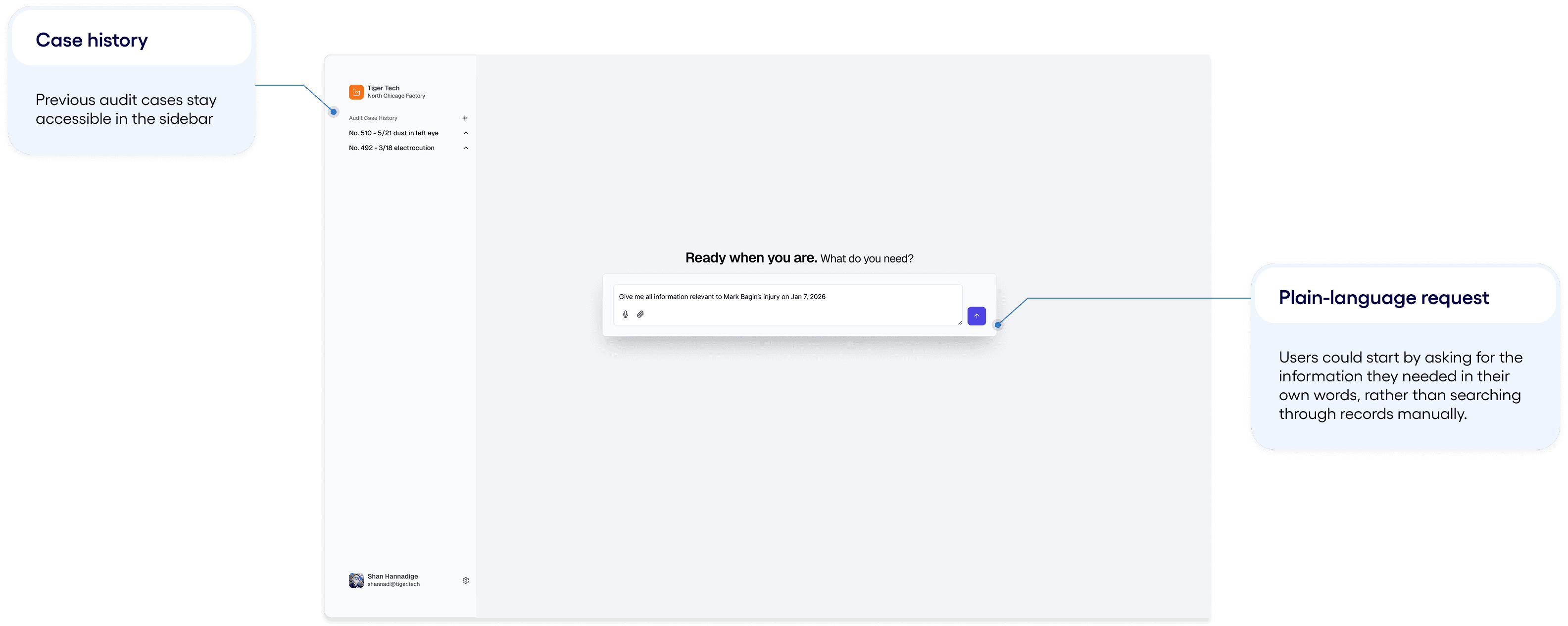
Start with what you need

Start with what you need

The safety manager enters the information they are trying to gather, and the system begins finding the records and evidence that could support it.

Step 2

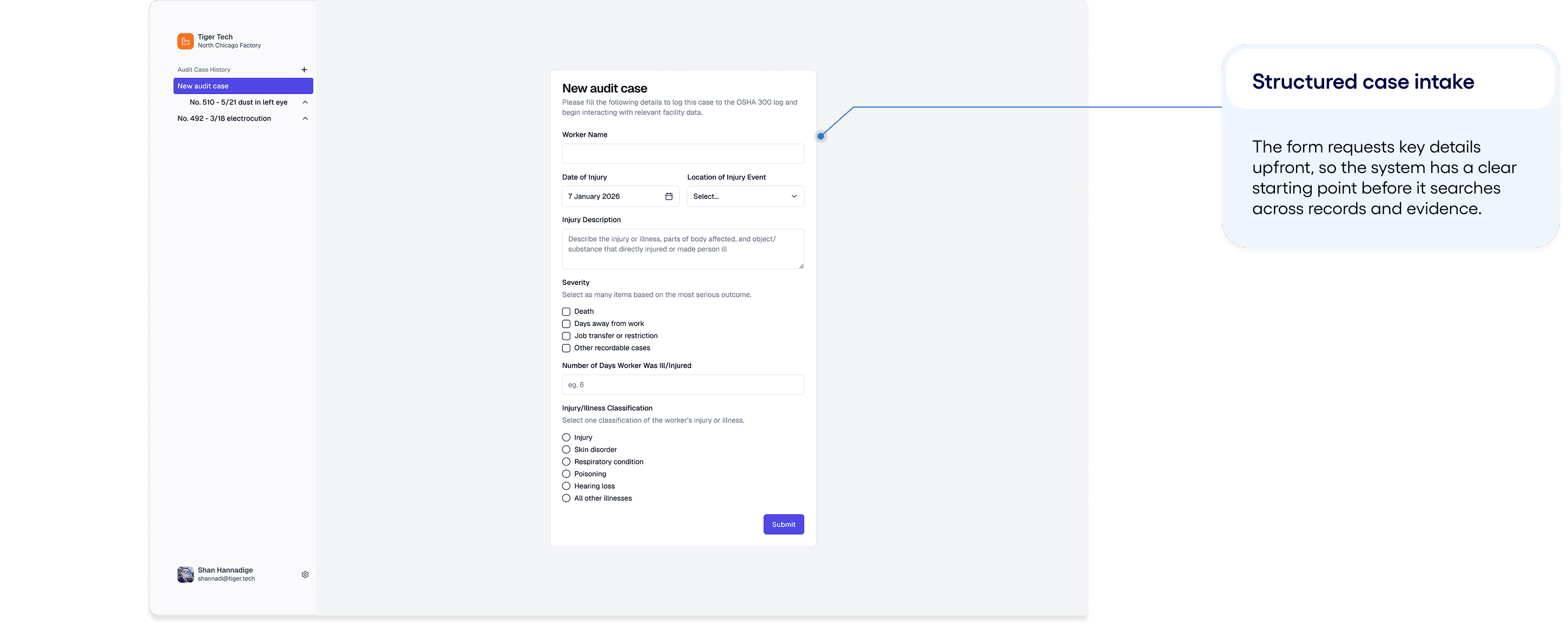
Capturing case details

Capturing case details

The intake form captures the core case details so the system has enough context to retrieve relevant details and build a case.

Step 3

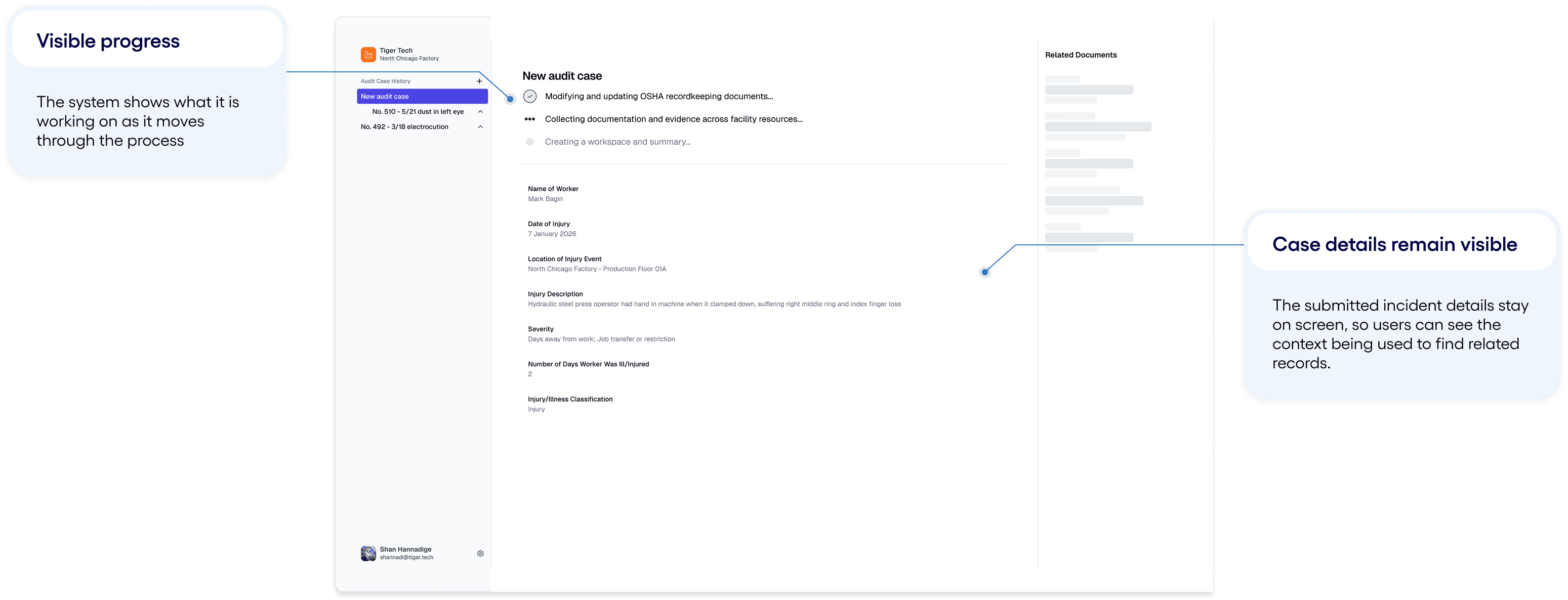
Building the case from available records

Building the case from available records

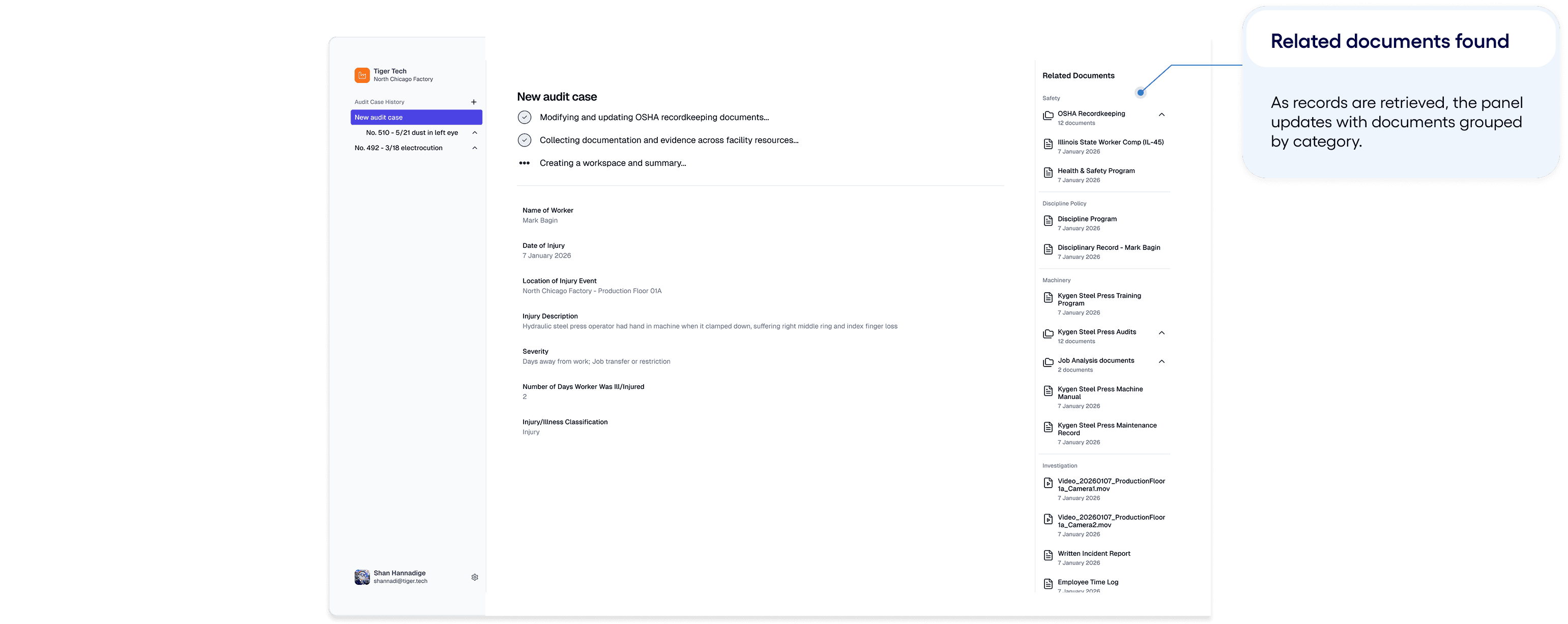
Once the case details are submitted, the system begins parsing available records and collecting the documents connected to the incident.

Step 4

Collected evidence summary

Collected evidence summary

The AI parses through all the available records and presents the case details, collected documents, and an initial summary in one place, with all the sources available in the side panel.

Step 5

Asking follow-up questions

Asking follow-up questions

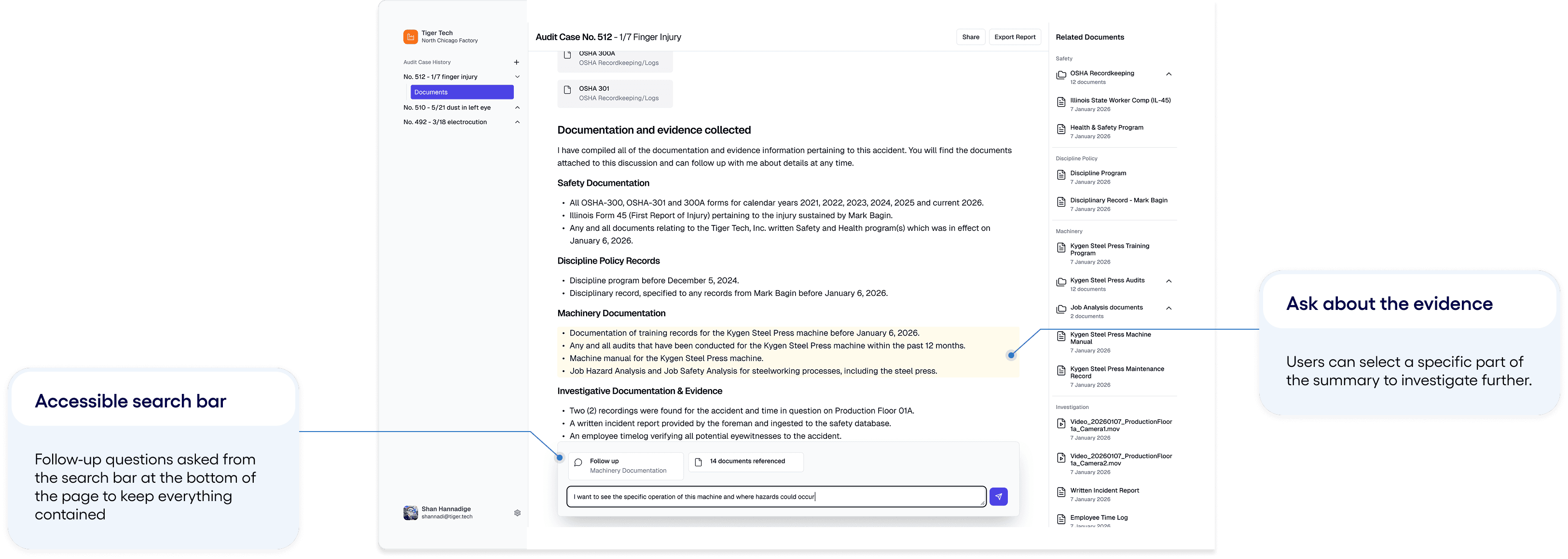
Any area can be investigated further by asking a more specific question within the same workspace, with follow-up questions building on what has already been found, rather than sending the user back to a new search.
Step 6

Digging deeper into specific evidence

Digging deeper into specific evidence

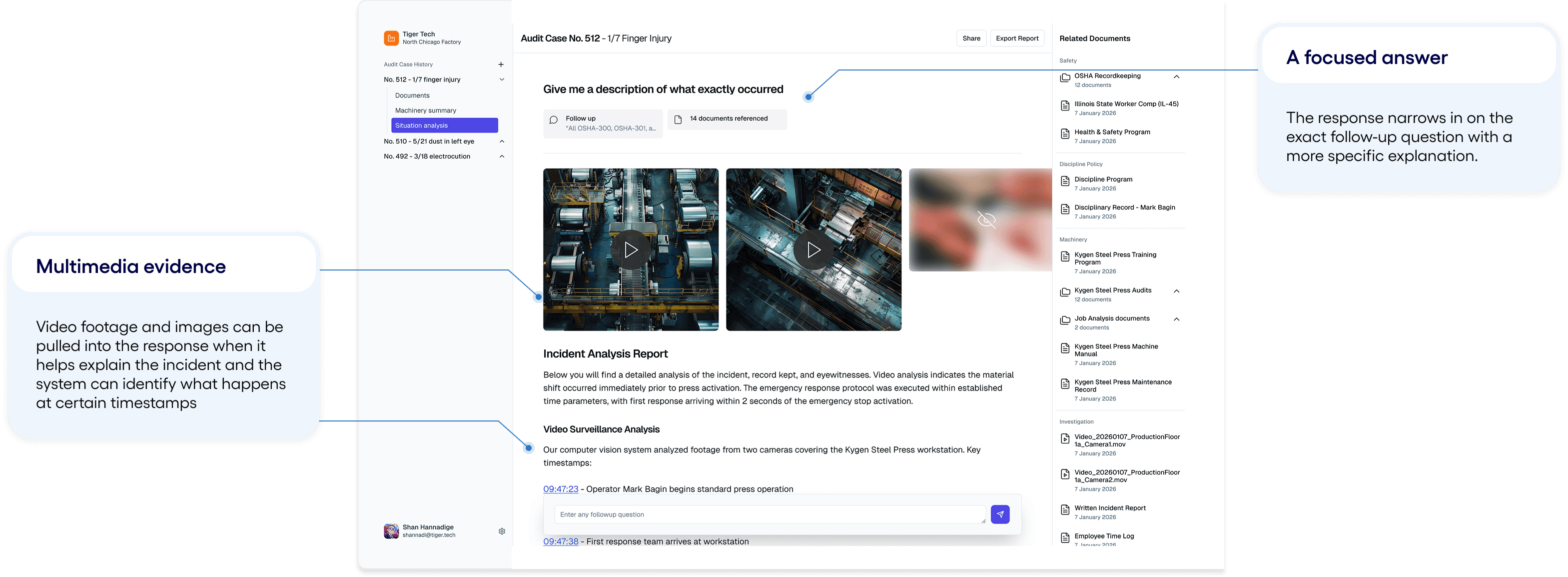
Once a follow-up question is submitted, the AI re-parses the relevant documents and provides a more focused summary, with the available evidence presented upfront.
Reflection

Turning the AI model into a usable review flow

This project showed me that AI works best when it supports the person doing the work, rather than trying to replace their judgment. When the records already exist but are spread across documents and resources, AI is most useful as an assistant that can help gather and organise that information.

For future iterations, I would explore clearer ways to show when information is missing and when a response needs further checking.

Future Considerations

Source confidence

Show why a record was retrieved and how strongly it supports the answer.

State missing evidence

Make it clear when the system cannot find enough information.

Digital handoff

A packaged summary of the collected evidence to digitally share with auditors.

Reflection

Turning the AI model into a usable review flow

This project showed me that AI works best when it supports the person doing the work, rather than trying to replace their judgment. When the records already exist but are spread across documents and resources, AI is most useful as an assistant that can help gather and organise that information.

For future iterations, I would explore clearer ways to show when information is missing and when a response needs further checking.

Future Considerations

Source confidence

Show why a record was retrieved and how strongly it supports the answer.

State missing evidence

Make it clear when the system cannot find enough information.

Digital handoff

A packaged summary of the collected evidence to digitally share with auditors.

Reflection

Turning the AI model into a usable review flow

This project showed me that AI works best when it supports the person doing the work, rather than trying to replace their judgment. When the records already exist but are spread across documents and resources, AI is most useful as an assistant that can help gather and organise that information.

For future iterations, I would explore clearer ways to show when information is missing and when a response needs further checking.

Future Considerations

Source confidence

Show why a record was retrieved and how strongly it supports the answer.

State missing evidence

Make it clear when the system cannot find enough information.

Digital handoff

A packaged summary of the collected evidence to digitally share with auditors.

Reflection

Turning the AI model into a usable review flow

This project showed me that AI works best when it supports the person doing the work, rather than trying to replace their judgment. When the records already exist but are spread across documents and resources, AI is most useful as an assistant that can help gather and organise that information.

For future iterations, I would explore clearer ways to show when information is missing and when a response needs further checking.

Future Considerations

Source confidence

Show why a record was retrieved and how strongly it supports the answer.

State missing evidence

Make it clear when the system cannot find enough information.

Digital handoff

A packaged summary of the collected evidence to digitally share with auditors.

Reflection

Turning the AI model into a usable review flow

This project showed me that AI works best when it supports the person doing the work, rather than trying to replace their judgment. When the records already exist but are spread across documents and resources, AI is most useful as an assistant that can help gather and organise that information.

For future iterations, I would explore clearer ways to show when information is missing and when a response needs further checking.

Future Considerations

Source confidence

Show why a record was retrieved and how strongly it supports the answer.

State missing evidence

Make it clear when the system cannot find enough information.

Digital handoff

A packaged summary of the collected evidence to digitally share with auditors.